



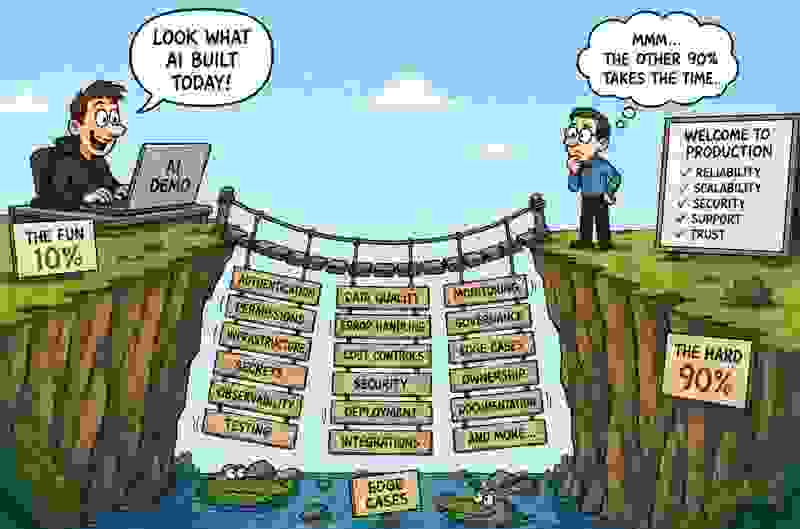
Everyone is talking about AI these days. With a few clever prompts, a useful tool or a little code, you can achieve impressive results in a very short time. Building a working AI demo? That is becoming faster and easier than ever.
But as the illustration clearly shows: building an AI demo is only 10% of the work. The other 90% starts afterwards.
An AI demo is an initial demonstration of what is technically possible. A production-ready AI solution takes things a step further: it is secure, reliable, scalable, integrated with existing systems and suitable for everyday use.
From AI demo to production-ready solution
There is a significant difference between an impressive demo and an AI solution that can actually be used within an organisation.
A demo often only needs to do one thing well: demonstrate what is technically possible. A production environment comes with very different requirements. You need to consider aspects such as:
- Security: Who should have access to which data and functionality?
- Privacy and authentication: How do we protect users and sensitive information?
- Data quality: Does the AI perform reliably when working with incomplete, inconsistent or unexpected data?
- Reliability: What happens when an integration fails or an AI model produces an unexpected response?
- Monitoring: How do we track performance, errors and costs?
- Governance: Who is accountable for the outcomes, and how do we maintain control?
- Integrations: How does the solution connect with existing systems and business processes?
- Documentation and maintenance: Can another team understand, maintain and further develop the solution?
And that is before we even consider testing, deployment, scalability, infrastructure, access management and edge cases.
Why AI implementation is more complex than building a prototype
Because AI tools have made prototyping so accessible, organisations risk underestimating the complexity involved.
A successful demo creates excitement and raises expectations. But enthusiasm alone does not make a solution suitable for everyday use. What works in a controlled demonstration can encounter all kinds of unexpected situations in practice.
Think of unusual user queries, changing datasets, peak workloads, security risks or dependencies on external AI services.
The real challenge is not simply getting AI to do something. It is making sure it continues to work securely, reliably, manageably and at scale.
How do you make an AI solution production-ready?
A successful AI implementation requires a structured approach. Several elements are essential:
- Architecture: Choose a solution that fits your existing IT environment and future requirements.
- Security and privacy: Ensure proper access management, data protection and secure information processing.
- Data quality: Make sure the data being used is reliable, up to date and suitable for its intended purpose.
- Testing: Test not only ideal scenarios, but also failures, exceptions and unexpected user input.
- Monitoring: Measure performance, reliability, usage and costs.
- Governance: Establish clear responsibilities, control mechanisms and operational processes.
- Integration and maintenance: Ensure seamless integration with existing systems and establish a clear maintenance structure.
By addressing these aspects from the start, you reduce the risk of a promising AI demo failing when it comes to deployment in a production environment.
Where the real value lies
Successfully implementing AI requires more than technical creativity. It requires architecture, security, data engineering, testing, maintenance and a thorough understanding of the business processes in which the solution will operate.
This also means organisations need to rethink how they approach AI projects. Do not just allocate time and budget to building a prototype. Invest in taking it into production and maintaining it afterwards.
A demo shows what is possible. A production-ready solution, properly deployed and maintained, demonstrates what actually delivers value.
Frequently asked questions about AI in production
Why is AI implementation more complex than you might think?
Because production environments introduce additional requirements around security, privacy, data quality, monitoring, governance, integrations and reliability.
What does it take to bring AI into production?
A solid architecture, reliable data, security measures, thorough testing, monitoring, governance and a clearly defined maintenance structure.
How do you make an AI solution scalable?
By considering infrastructure, performance, user workloads, costs, integrations and maintainability from the very beginning of the design process.
Why are AI governance and security important?
They ensure that AI is used responsibly and under control, that data remains protected and that accountability for the system's operation and results is clearly defined.
What is the difference between an AI proof of concept and a production-ready AI solution?
An AI demo proves that a particular functionality is technically possible. A production-ready solution goes further: it has been tested, secured, made scalable, integrated and prepared for everyday use.
Ready to take the next step with AI?
An AI prototype is a great starting point. But the real value emerges when the solution becomes a reliable part of your organisation and its existing digital landscape.
Looking to go beyond a demo and actually integrate AI into your digital environment? I'd be happy to help you explore the architecture, development and implementation.
